



Why that is not a conflict of interest and why the distinction matters.
A question that arises on many projects is whether a fire safety consultant who develops a Fire Life Safety (FLS) strategy can also conduct a third-party inspection on the same project. The argument sounds reasonable on the surface. It does not hold up under scrutiny and misrepresents how fire safety roles are structured on a project.
This article clearly sets out why developing an FLS strategy and inspecting fire protection systems are not in conflict, and which accreditation framework underpins that independence.
What the FLS Strategy Actually Does
A Fire Life Safety strategy establishes the fire safety framework for a building or structure. It brings together fire prevention, fire safety management, and fire protection requirements, drawing on prescriptive code compliance and, where applicable, performance-based design to demonstrate that the project’s agreed fire safety objectives are met.
The FLS strategy defines performance requirements across four areas: occupant life safety, property protection, operational continuity, and environmental impact.
In the UAE, the FLS strategy is developed in accordance with the UAE Fire and Life Safety Code of Practice, which sets out the prescriptive requirements and performance objectives that all buildings must satisfy. The Code provides the technical and regulatory basis against which the FLS strategy is benchmarked and, ultimately, against which any installed fire protection systems are assessed.
The FLS strategy defines what is required. It does not determine how those requirements are delivered.
Specifying that a wall requires a two-hour fire resistance rating is not the same as designing that wall, selecting the fire-stopping system, or choosing the fire door assembly. Those decisions belong to the architect, structural engineer, and specialist subcontractors.
Who Designs What and Why It Matters
When Vortex develops an FLS strategy, we establish the project’s fire safety performance requirements. We do not:
- specify or design the structural or architectural elements of rated walls or floors;
- select fire door or fire-rated glazing products;
- specify or design fire-stopping assemblies for service penetrations; or
- select brands, manufacturers, or installation methods.
Those decisions are made by the design team and contractors. Our role is to define the standard they must meet. Inspecting whether they have met it is a separate and independent function.
This distinction is recognised within the ISO 17020 framework itself. The standard draws a clear line between designing an item (e.g. a wall assembly, a fire door, a penetration seal) and designing the requirements that item must meet. Writing an FLS strategy is the latter. Vortex defines the fire-resistance rating a wall must meet. We do not design the wall. Under ISO 17020, these are categorically different activities, and the standard does not treat the authorship of a performance specification as disqualifying an inspection body from verifying compliance with it.
What Third-Party Inspection Actually Involves
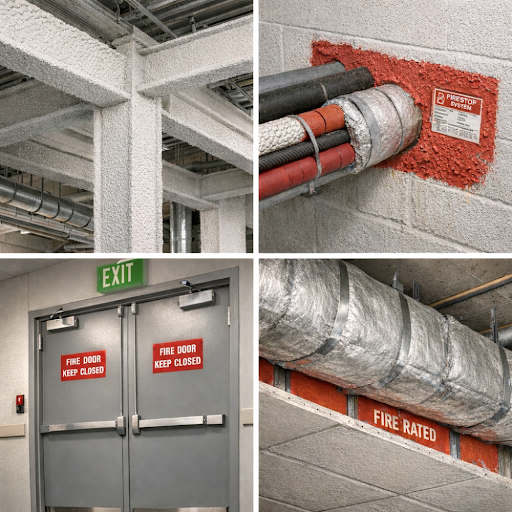
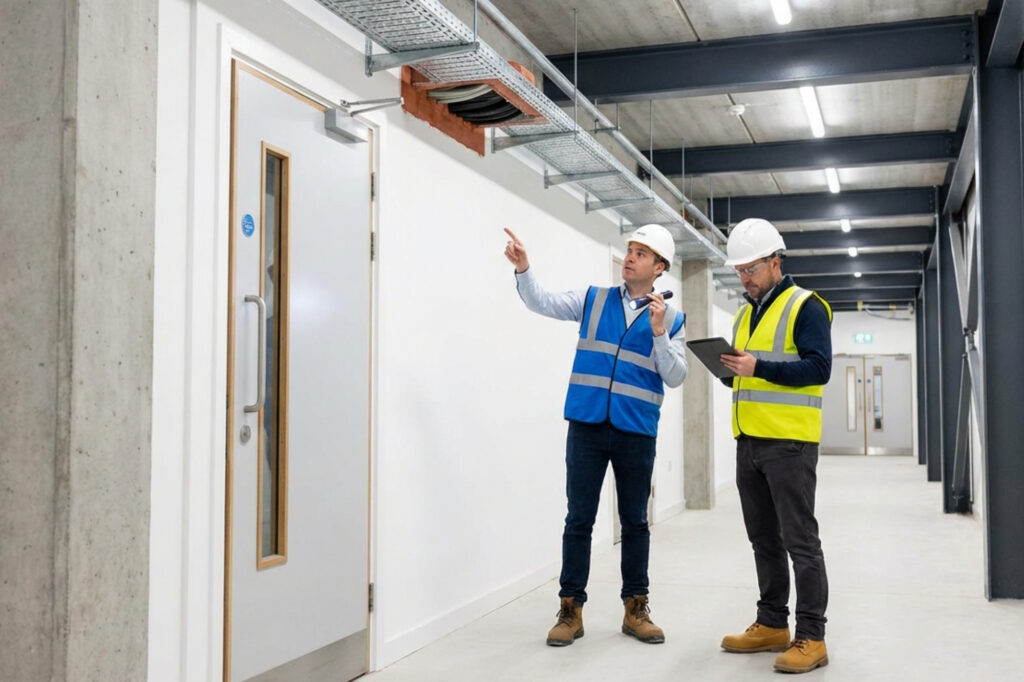
When Vortex carries out third-party inspection of passive fire protection systems, fire stopping of penetrations, compartmentation integrity, fire doors, and facades, we are not reviewing decisions we made. We are reviewing decisions made by others.
Specifically, during inspection, we verify:
- whether the proposed products and assemblies are approved for the specific onsite application;
- whether the system and applicator have been approved by the Civil Defence authority;
- whether they have been independently fire tested and certified for the intended application; and
- whether they have been installed correctly and in accordance with their tested and certified specifications.
A product may carry valid Civil Defence approval and a fire test certification, yet still be installed incorrectly or used outside its tested scope. Identifying that gap is precisely what third-party inspection is designed to catch. We are not checking our own work. We are checking whether others have met a standard we specified using products they selected, approved by the authority, and certified for that application.
We verify Civil Defence approval, fire test certification, suitability for the application, and correct installation. None of that involves reviewing decisions Vortex made.
The Analogy Is Simple
A structural engineer who specifies the load-bearing requirements for a floor slab does not have a conflict of interest when independently verifying whether that slab was constructed correctly. The specification and the inspection serve different purposes, involve different decisions, and are carried out by different parties within the project.
The same logic applies here. Establishing a fire safety performance standard and independently inspecting compliance with that standard are not the same activity. Mixing them or claiming they are does not reflect how fire safety roles operate on a project.
How ISO 17020 Classifies Vortex on This Type of Project
ISO 17020 establishes a formal classification framework for inspection bodies. The highest classification is Type A — a fully independent inspection body. To reach Type A classification, the inspection body must satisfy a structured decision-making process set out in the standard. The critical first question is this:
Is the inspection body part of a legal entity engaged in the design, manufacture, supply, installation, purchase, ownership, use or maintenance of the type of items inspected?
For Vortex on a project where we hold the FLS role, the answer is No. We are not engaged in the design, manufacture, supply, or installation of the passive fire protection systems being inspected — the walls, fire doors, penetration seals, or fire stopping assemblies. Under the ISO 17020 classification process, this answer routes directly toward Type A status: a fully independent inspection body.
ISO 17020 Clause A.1(b) states that inspection body personnel shall not be engaged in the “design, manufacture, supply, installation, purchase, ownership, use, maintenance of the item inspected.” Writing an FLS strategy, which defines performance requirements, not construction details, does not fall within any of those categories. The standard is clear on this point, and our accreditation body IAS applies this framework in assessing our classification.
The ISO 17020 framework also explicitly clarifies that exchanging technical information between the inspection body and the project team, such as explaining findings, clarifying requirements, or providing technical guidance, does not compromise Type A status. Holding the FLS role on a project, which inherently involves technical communication with the design team, is consistent with this clarification and does not affect the independence classification.
Accreditation as the Assurance of Independence
Assertions of independence are not sufficient on their own. Accreditation is the mechanism that provides verifiable, auditable assurance.
Vortex is accredited as a third-party Type A Inspection Agency to ISO 17020 by the International Accreditation Service (IAS). ISO 17020 is the internationally recognised standard for inspection bodies and imposes strict requirements on impartiality, technical competence, procedural independence, and conflict-of-interest management.
Our accreditation scope covers both active and passive fire protection systems, including building facades. As an approved Civil Defence House of Expertise in Dubai and Abu Dhabi, our inspection activities operate within a regulated framework with defined obligations and accountability.
The UAE Fire and Life Safety Code of Practice itself requires that third-party inspection be carried out by an accredited and approved inspection body. This is not an informal arrangement; it is a regulatory requirement. Vortex satisfies that requirement through its ISO 17020 accreditation and Civil Defence House of Expertise approval, both of which are subject to ongoing audit and renewal.
As part of maintaining ISO 17020 accreditation, Vortex is required to submit a formal management affidavit to IAS each year. That affidavit includes an explicit declaration on conflict of interest and a requirement to disclose any perceived conflicts arising from specific inspection assignments. Critically, the IAS accreditation framework itself states that “it is not, in and of itself, a conflict of interest for an independent and separate division of inspection to perform inspections.” This is the position of our accreditation body, not simply our own. IAS has considered this question and answered it. Our independence is not self-declared; it is attested annually, audited independently, and upheld by the body that grants and maintains our accreditation.
ISO 17020 accreditation not only permits us to conduct independent inspections; it also requires us to demonstrate and maintain the independence that makes those inspections credible.
The Bottom Line
Developing an FLS strategy and inspecting fire protection systems on the same project do not constitute a conflict of interest. The roles are structurally separate: one defines the performance standard, the other verifies whether it has been achieved on site. The products, assemblies, and installation methods being inspected are selected, designed, and executed by others, not by Vortex.
Under the ISO 17020 classification framework, Vortex qualifies as a Type A inspection body for these projects, the highest level of independence the standard recognises. Our accreditation body, IAS, has explicitly addressed this question within its framework and confirmed that an independent inspection division is not, in and of itself, a conflict of interest. This is not our assertion. It is the body’s position that accredits us.
The ISO 17020 standard, the IAS accreditation framework, and the UAE Fire and Life Safety Code of Practice are all consistent on this point. Vortex’s independence is not self-declared; it is defined by the standard, assessed by our accreditation body, and maintained through annual audit. Clients, authorities, and project stakeholders can take confidence from that framework, and we welcome any questions about how it applies to a specific project.
About Vortex
Vortex is a specialist fire safety engineering and code consultancy operating across the UAE, Australia, and Canada. The UAE offices are accredited to ISO 17020 by the International Accreditation Service (IAS) and approved as a Civil Defence House of Expertise. Vortex provides fire life safety strategy, performance-based design, third-party inspection, and authority coordination services across a broad range of building types and sectors.