



Passive fire protection is one of the most critical and least visible elements of building fire safety. Unlike active systems such as alarms and sprinklers, passive fire protection elements are concealed behind walls, above ceilings, inside shafts, and around service penetrations. Once covered, they cannot be function-tested or easily inspected.
This makes the construction stage the only practical window for proper verification.
A Clear Regulatory Framework Is Already in Place
The UAE Fire and Life Safety Code of Practice sets out clear requirements for passive fire protection quality, inspection, and verification. Reinforcing this, the General Command of Civil Defence issued a dedicated circular on 8 June 2023 specifically addressing passive fire stopping and strengthening compliance expectations across projects.
These are enforceable standards, not guidance notes, and they apply across all project types.
What Happens When Verification Is Missed
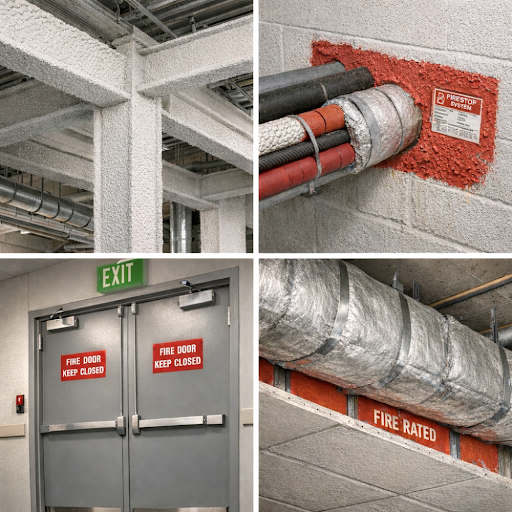
Passive fire protection elements, including fire-stopping of service penetrations, fire-rated walls and shafts, fire dampers, fire-resistant joints, and structural fireproofing, must be inspected before concealment. If non-compliances are missed at this stage, they become a permanent part of the building’s construction.
Rectification after handover is costly, disruptive, and in many cases requires destructive investigation to locate and address defects.
The Gap Between Design and Installation
Even when design strategies and drawings are fully compliant, site conditions can cause deviations. Fast-track programmes, multiple subcontractors, material substitutions, and the complexity of coordinating multiple trades all create the risk of execution gaps.
Structured construction-stage inspections are the mechanism that bridges design intent and installed reality — ensuring that what is built matches what was approved.
Common Installation Observations
Across complex construction projects, typical passive fire protection findings include:
- Incorrect fire-stopping systems specified for the penetration type
- Service penetrations left partially or fully unsealed
- Fire-rated walls not extended to the structural slab
- Improper installation of fire dampers
- Inconsistency in workmanship across different floors or zones
Early-stage inspection, rather than end-of-project review, is the most effective way to identify and resolve these issues before they are sealed behind finishes.
Why Inspection Quality Matters
Effective passive fire protection inspection goes beyond presence on site. It requires technical competence, independence, systematic methodology, and traceable documentation.
ISO 17020 accreditation for inspection bodies provides assurance that these standards are consistently met — offering developers, contractors, and building owners confidence that inspection findings are impartial, technically sound, and audit-ready.
A Shared Responsibility Across the Industry
Passive fire protection directly affects life safety during a fire event, smoke containment and compartmentation, fire spread control, firefighter access and safety, and long-term resilience.
Non-compliances that arise during construction do not resolve themselves at handover. They remain embedded in the building’s fire-safety performance throughout its operational life.

As the UAE continues to deliver some of the most ambitious built-environment projects in the world, ensuring that passive fire protection is properly verified early, independently, and consistently remains a shared responsibility across the entire project delivery chain.
Compliance does not end at design approval. It must be verified through construction and maintained across the building’s full life cycle.